Today I published the first Games Industry Listings Report on Games Jobs Index. It’s something I’ve wanted to do since I started the board: use the data the board already collects to say something about the games industry, not just list roles.
Why this data is different
Every day, Games Jobs Index reads each studio’s own careers system directly: 1,383 studios with open listings on 1 November, and 15,324 open listings.
Because it reads the same studios every day, it can see something most job boards can’t: when a listing first appears, how long it stays up, and when it comes down. That’s what the report is built on.
A split market
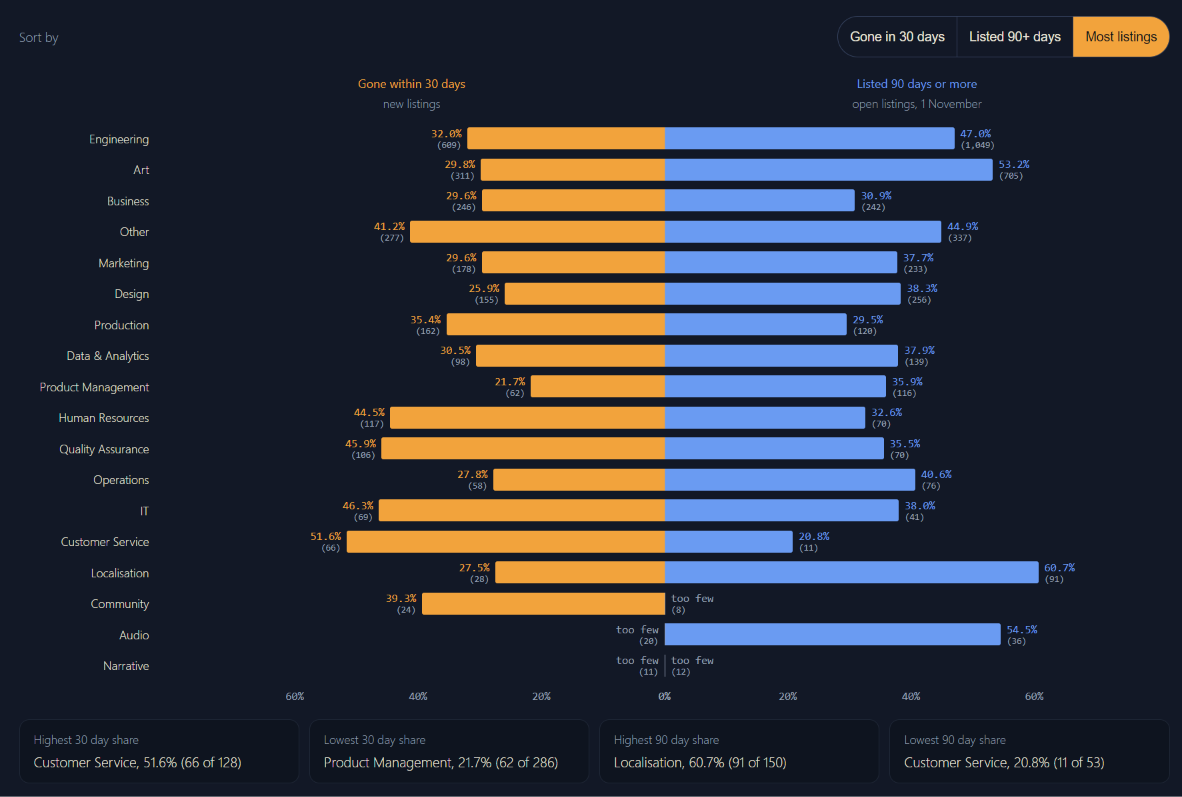
The headline finding is that the market is split.
Of the new listings Games Jobs Index first saw between 4 July and 25 September, at studios with stable listing ids and where the outcome is known, 32.7% (2,597 of 7,931) were taken down within 30 days.
At the same time, 42.4% (3,612 of 8,523) of the open listings whose age we can measure had been up for 90 days or more.
So some roles move very fast and others sit for months. My reading is that studios move quickly on a few very specific hires and leave other roles open for a long time, either holding out for the right (often senior) person or keeping the listing up while they work out 2027 budgets.
One word of caution: a listing coming down doesn’t tell us the role was filled. It only tells us the studio stopped advertising it.
Breaking in is still hard
Even in October, intern and graduate season, entry-level roles were only 11.5% (343 of 2,975) of the new listings we first saw.
Against tens of thousands of games industry roles cut over the past few years, studios seem to be playing it safe and favouring experience over juniors. gaminglayoffs.com estimates about 12,242 games industry layoffs so far this year, around 885 of them in October.
A small group of big studios
Openings are also concentrated. The 10 studios with the most open listings, among them KURO GAMES, Cygames Group and Ubisoft, held 17.1% (2,621 of 15,324) of all open listings on the board, about one in six. That means a lot of competition for roles held by a small group of big studios.
What’s in the full report
The report itself goes further than this post:
- how long roles stay open, including by region;
- which studios are listing the most roles;
- where the listings are, country by country;
- how work arrangements are advertised (most listings say nothing at all);
- how the discipline mix of new listings is shifting month to month;
- a full method section, and every figure as a CSV download.
Read it here: https://gamesjobsindex.com/report/2026-10.html
What’s next
The report will come out at the start of every month, with the numbers frozen on the 1st. Because the board has only been reading studios this way since July, some comparisons (like this year against last) have to wait until there’s a full year of data. I’d rather wait than guess.
If there’s a question you’d like the data to answer, I’d love to hear it. And if you’re looking for work in games, every listing in the report is on the board, straight from the studio: https://gamesjobsindex.com/
